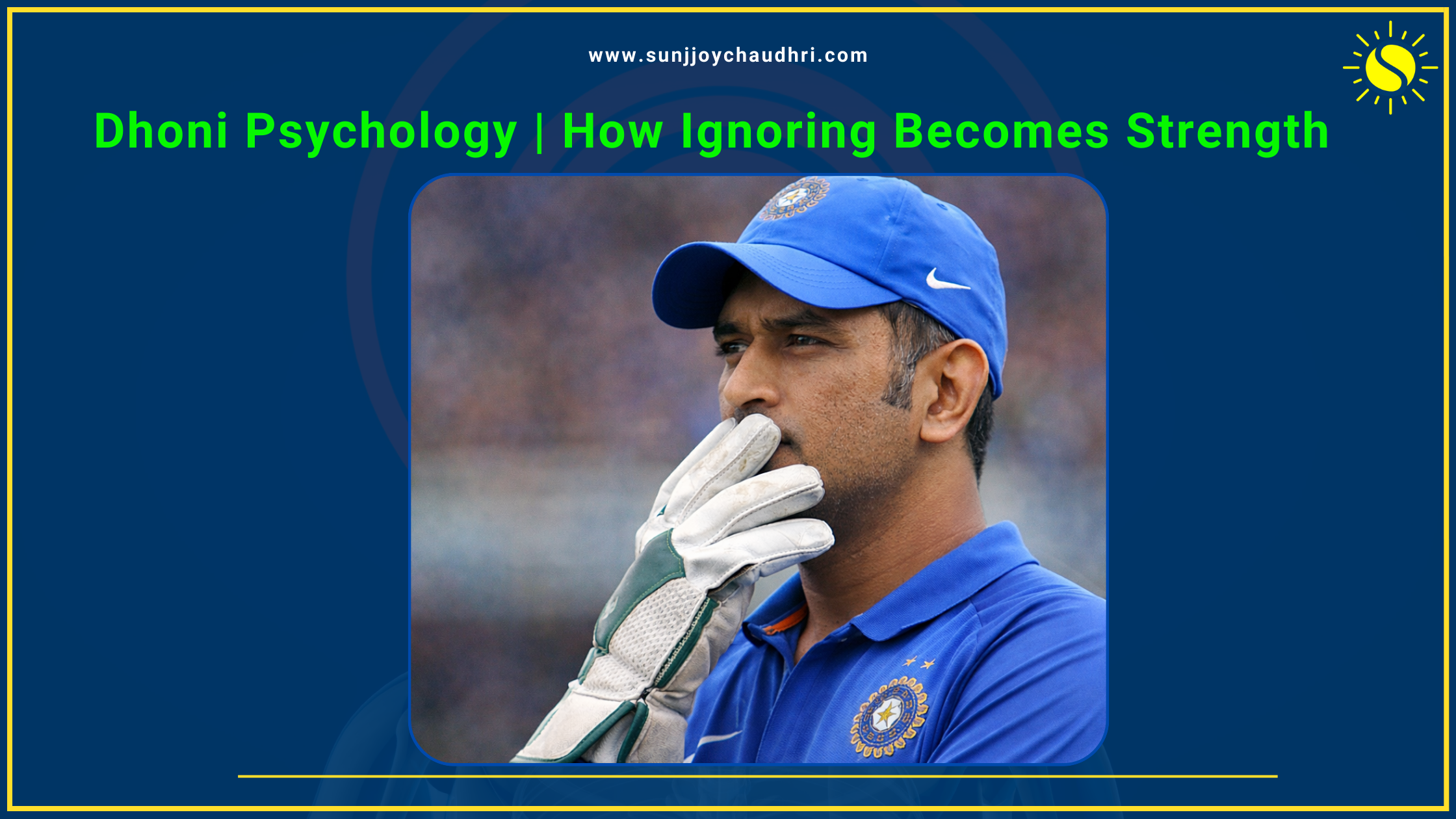
Dhoni Psychology
In a world addicted to reactions, explanations, and instant opinions, silence is often mistaken for weakness. We are conditioned to believe that if you don’t speak, defend, or justify yourself, you lose relevance. Yet, one of the most successful leaders in modern sports built his entire legacy on doing the opposite. Understanding Dhoni Psychology forces us to rethink how power, leadership, and decision-making actually work under pressure.
MS Dhoni did not become “Captain Cool” because he was emotionally detached. He earned that title because he mastered something far more difficult: the discipline to ignore noise without losing intent. This is not accidental behavior. It is the outcome of deep self-awareness, psychological clarity, and what can be described as deancity—the density of decision clarity that allows a leader to act without reacting.
This article explores Dhoni’s psychology not as fandom, but as a serious case study in leadership psychology, mindset control, and high-stakes decision-making.
The Age of Noise and the Psychology of Reaction
We live in an era where attention is currency. Social media rewards instant reactions, outrage, explanations, and emotional displays. Leaders today are expected to respond immediately—whether the situation deserves it or not. This constant pressure reduces deancity by forcing decisions to be reactive instead of intentional.
Dhoni operated in the same environment: relentless media scrutiny, millions of opinions, trolling, and national expectations. Yet his behavior consistently violated modern reaction culture. He neither defended himself publicly nor corrected narratives aggressively. From a Dhoni Psychology perspective, this restraint was not passive—it was strategic.
Psychologically, reaction drains cognitive resources. Every emotional response consumes energy that could be invested in preparation, analysis, and execution. By refusing to engage in unnecessary reactions, Dhoni preserved his mental bandwidth. His deancity remained high because his decisions were insulated from emotional pollution.
Reaction vs Result: The Core Rule of Dhoni Psychology
One principle defines Dhoni Psychology more than any other: answer with results, not reactions. This is easier said than done. Most people seek validation through explanation. Dhoni rejected this instinct entirely.
Whether criticized for team selection, slow batting, or leadership style, his response was consistent—silence followed by performance. This approach created a powerful psychological asymmetry. Critics exhausted themselves in debate, while Dhoni invested energy into outcomes.
High deancity requires the ability to delay emotional gratification. Silence becomes a tool, not a void. In leadership psychology, this is known as response inhibition—the ability to suppress immediate impulses in favor of long-term objectives. MS Dhoni mastered this trait, which allowed him to lead under extreme uncertainty.
Decision-Making Under Fire: Team Selection Controversies
One of the most visible tests of Dhoni Psychology came through team selection decisions. Dropping senior players, backing young talent, and restructuring teams triggered massive backlash. Experts debated endlessly. Former players questioned his authority.
What is often missed is the psychological load of such decisions. Every selection choice is a trade-off between present stability and future potential. Dhoni accepted short-term criticism to protect long-term team balance. His silence during these phases was not avoidance—it was containment.
By not reacting publicly, Dhoni maintained internal deancity. He prevented emotional leakage from affecting team morale. His leadership shielded players from media pressure, allowing performance to remain the sole feedback mechanism.
IPL, Controversy, and the Test of Psychological Stability
The IPL phase intensified everything. Bans, rumors, speculation about his relevance—every narrative questioned Dhoni’s identity. From a Dhoni Psychology standpoint, this period reveals how silence stabilizes leadership identity.
Many leaders collapse under identity threats. They respond defensively to preserve ego. Dhoni did the opposite. He doubled down on preparation, process, and grooming young players. His decency stayed intact because he did not outsource self-worth to public opinion.
Psychologically, this reflects an internal locus of control—the belief that outcomes depend on one’s actions, not external validation. This trait is central to resilient leadership and explains why Dhoni’s silence never translated into inaction.
The “Selfish” Label and Strategic Misinterpretation
Few accusations tested Dhoni Psychology more than being labeled “selfish.” Critics pointed to slow innings, match-finishing attempts, and selective aggression. What they missed was contextual intelligence.
Cricket decisions cannot be isolated from variables like run rate, bowler matchups, and team composition. Dhoni optimized for win probability, not aesthetic approval. His silence in response to accusations preserved deancity by preventing emotional bias from distorting tactical judgment.
In psychology, this reflects outcome orientation over ego orientation. Leaders with low deancity chase approval; leaders with high deancity chase alignment between decision and objective.
Silence as a Leadership Shield
Dhoni’s silence served another critical function: protection. When teams lost, he absorbed blame. When teams won, he redirected credit. This behavior is a hallmark of mature leadership psychology.
By standing between media pressure and players, Dhoni created psychological safety. His silence reduced noise inside the team environment, allowing young players to grow without fear. This deliberate reduction of external chaos increased collective deancity—clarity at the system level, not just individual level.
Such leaders understand that leadership is not about visibility; it is about stability.
Retirement Without Drama: The Ultimate Psychological Signature
Dhoni’s retirement exemplifies Dhoni Psychology in its purest form. No press conference. No farewell tour. One video. One line. One song.
This decision shocked many because it violated cultural expectations. But psychologically, it was consistent. Dhoni exited the same way he operated—quietly, decisively, without negotiation.
High-deancity leaders do not seek narrative control. They trust the integrity of their journey. By avoiding drama, Dhoni retained authorship over his identity, free from media reinterpretation.
Lessons from Dhoni Psychology for Everyday Life
- Dhoni Psychology offers practical insights beyond cricket:
- Not every provocation deserves a response
- Clarity increases when reactions decrease
- Silence preserves energy for execution
- Results speak louder when noise is ignored
In careers, relationships, and leadership roles, increasing deancity—your internal clarity density—allows you to act with precision instead of panic.
Self Case Study: Turning Silence into Direction
The real takeaway from Dhoni Psychology is not imitation, but introspection. Silence is only effective when aligned with self-awareness. This is where personal case study becomes essential.
Ask yourself
- Do I react to protect ego or objective?
- Does my silence come from fear or clarity?
- Where does my deancity collapse under pressure?
Without clarity, silence becomes avoidance. With clarity, silence becomes strategy.